
How long the Great Pyramid took to build
· 4 min read
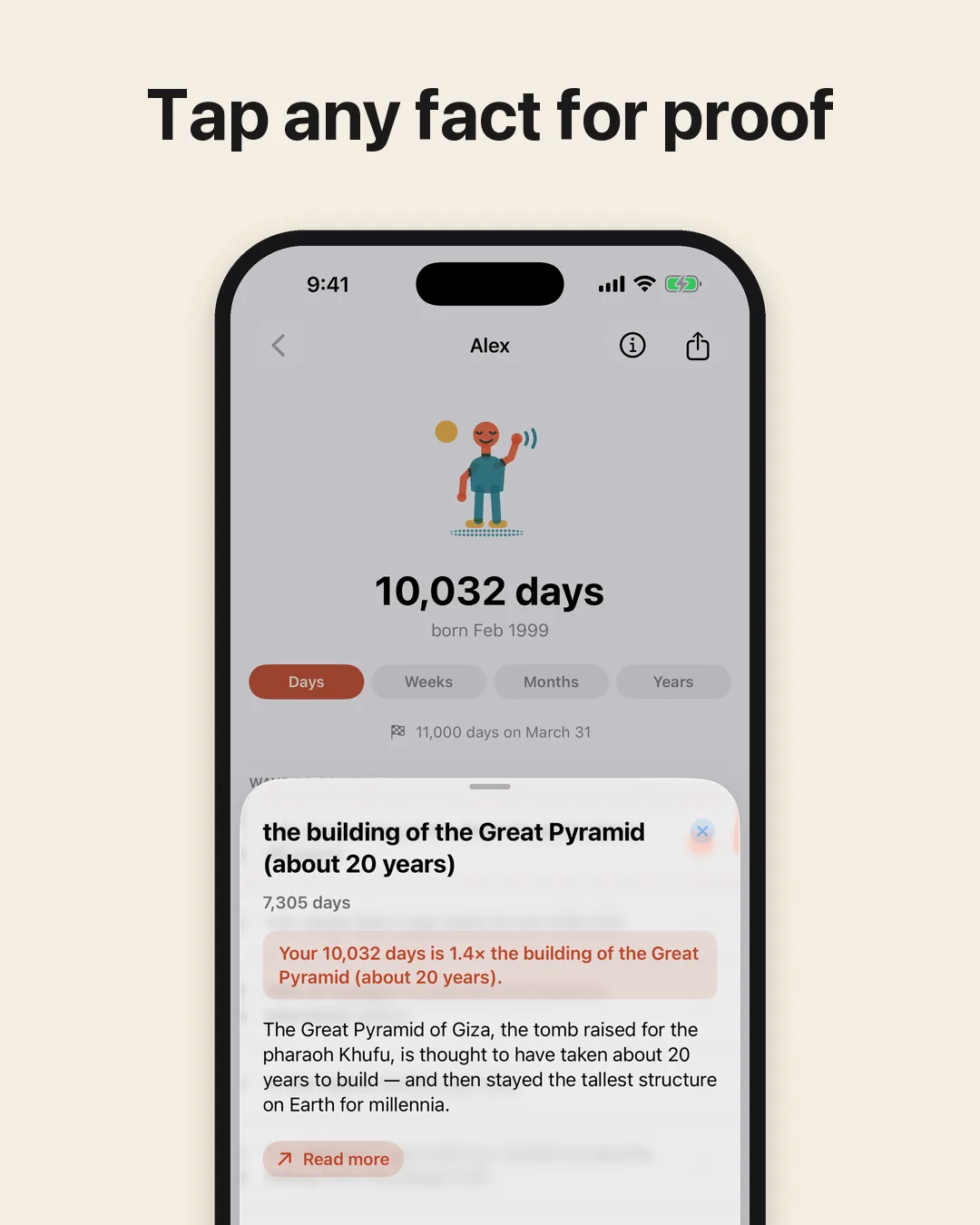
When TapSmart wrote about this app last week, the line they picked was the pyramid one: 10,032 days alive works out at roughly 1.4 times as long as it took to build the Great Pyramid of Giza. That comparison divides by 7,305 days, or twenty years. It is worth saying where that number comes from, because it is the shakiest figure in the whole catalogue.
Twenty years is one man's estimate
It comes from Herodotus, who visited Egypt around 450 BC and reported that 100,000 men worked in three-month shifts for twenty years, ten of which went on the causeway before a single block of the pyramid was laid.
The pyramid was already about two thousand years old when he heard that. He did not read it in an Egyptian record. He was told it, by guides, in a country whose language he did not speak, about a building site nobody alive had seen. Egyptologists treat the figure as folklore that happens to be in the right region.
The archaeology says closer to twenty-six
Three independent lines of evidence point higher. Radiocarbon dates from mortar samples place construction in a window ending around 2604 BC. The workers’ settlement excavated at Giza shows a permanent skilled workforce rather than Herodotus’s seasonal army of a hundred thousand. And experimental archaeology, measuring how fast people can actually cut and move limestone, lands at roughly 250 blocks a day from about 3,500 quarrymen, which finishes the job in twenty-six or twenty-seven years.
There was time for it. Radiocarbon puts Khufu’s reign at about 2613 to 2577 BC, so a twenty-six year project still ends with a decade to spare.
So the app uses the low figure
It does, and now you know. Twenty years is what almost every source you will find says, it is the figure attached to the comparison, and it is probably six years short. The honest version of the fact is a range: somewhere between twenty and twenty-six years, and nobody living knows which end.
That does not make the comparison useless. Ten thousand days against the pyramid is still the right order of magnitude, and the point of it was never precision to the day. It is the same problem as counting the stairs in a building: the number is fine once you know what it was measuring, and misleading the moment it is quoted without that.
Which is why every comparison in the app carries a link. Not so the number looks authoritative, but so you can go and disagree with it.